Congratulations to our 2017 Don Low Communications
Fellowship recipients
Aldo Franco and Jonathon Bouma
Aldo
has over 20 years of experience in Public Health Protection, most recently as
Manager, Health Protection and Investigation with the Region of Waterloo Public
Health & Emergency Services. He currently manages and provides oversight to
the planning and delivery of Health Protection Programs, including leading
the Food Safety, Small Drinking Water Systems and Recreational Safe Water portfolios.
Jonathon is the Manager of Environmental
Health and Communicable Disease Control with Algoma Public Health in Sault St.
Marie. He manages a number of programs including Safe Water, Infectious
Diseases Prevention and Control, Tobacco Enforcement, Food Safety, Rabies,
Health Hazard, Land Control (OBC Part VIII), as well as Infection Control
,Tuberculosis and Travel Health programs.
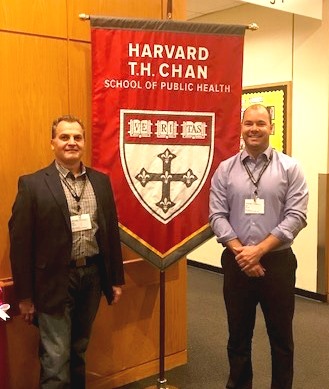 For their fellowships, both Aldo and Jonathon attended the Applied Risk Communications for the 21st Century course at the Harvard T.H. Chan School of Public Health in Boston. Their learnings will enhance their risk management and communications skills to better serve their health units and the public health sector.
Highlights from both fellowships are detailed in the reports below.
Aldo (left) and Jonathon (right) at Harvard.
Aldo’s experience
I am honoured to have been co-awarded the Sheela
Basrur Centre’s 2017 Don Low Communications Fellowship. Particularly in association,
and recognition, of two distinguished leaders in public health risk communication,
Dr. Donald Low and Dr. Sheela Basrur. With this opportunity, I enrolled in the Harvard
School of Public Health’s Applied Risk Communication for the 21st Century in
March.
I was proud of being considered a student, of such
an esteemed academic institution ,even if it was for a short three-day
workshop. I was amazed at the reach of
this workshop and having the opportunity to meet so many people from far and
wide across the globe. There were participants from Cote d’Ivoire, Nigeria, New
Zealand, Japan, Malaysia, South Korea, Denmark, Netherlands, Sweden, and of
course USA and Canada. The diversity of participants and expertise was thought-provoking
and offered different perspectives and experience to draw from.
There were
representatives from all levels of government, such as, Food and Drug
Administration, US Coast Guard, US Military, EPA, US Nuclear Commission, Health
Canada, Public Health Agency of Canada, to name a few, and local public health
from the US and Canada. There were also
attendees from private sector companies.
The course organizer, Dr. K.
Viswanath, touched upon topics like health risk communication
and technology; leadership in crisis and risk communication; challenges in
communicating risk with media; behavioral economics; and emotions and
communication of risk. There was also a case study about a contaminated
drinking water emergency from West Virginia that was very impactful, as it
brought it home to a situation could be me on any given day.
The course included high level lectures, case studies,
role play and activities however, the discussions and networking were invaluable.
The skills learned throughout the workshop will be easily applied to my
day to day work and career. I would highly recommend this program for anyone
who has an interest in developing their risk communication skills, or
experience in dealing with crisis situations and media requests on a regular
basis.
I want to extend a sincere thank you to the Sheela
Basrur Centre for this opportunity and Dr. Viswanath for hosting a great
program.
Jonathon's experience
I was
thrilled to have been chosen to receive the Sheela Basrur Centre’s 2017 Don Low
Communications Fellowship and was able to attend the Harvard School of Public
Health’s Applied Risk Communication for
the 21st Century course March 26-28 in Boston. I expected to
receive high level executive teachings on risk communications
and was not disappointed. What I did not expect was the wonderful
experience of this course delivery paired with the breadth of professions and
expertise in other course attendees. Participants from all over the globe
representing not only public health but environmental, nuclear, academia,
marketing, military branches and private industry contributed to a rich
discussion environment that influenced the positive experience of the week.
Lunch and break times were filled with engaging discussions on challenges
faced in communicating science and medicine in our job settings.
The case
scenarios and lectures were international in nature and showcased the extensive
research that is essential but often overlooked by some in public health - how
to effectively communicate what we know to effect health behaviour change in a
world filled with many messages, some of which conflict at times. I have
taken much from the lectures and examples of both good and bad campaigns to
inform my agency’s work in this area. The frank and open discussion around real
life scenarios such as the West Virginia chemical spill in its waterways and the variety of challenges faced by the leader of the Environmental Protection Agency,
resonated with me.
I found
this course to be certainly informative and eye opening but also inspiring to the
attendees, motivating us to keep improving so that we can collectively make a
positive impact on the health of those we serve.
I am very
grateful for the opportunity to attend this engaging program and would like to thank the Sheela Basrur Centre and
Algoma Public Health for their support.