|
|
Page Content Past Lectures
In May 2016 Alberta underwent the
largest evacuation in its history with approximately 82,000 residents displaced
by the wildfires in Fort McMurray.
“Wildfire at Fort McMurray
Alberta: Local action through leadership, communication and collaboration”, took
the audience on a day-by-day account of the emergency response to the Fort
McMurray wildfires, from the point the disaster was declared a state of
emergency, through to the mass evacuation of the area and re-entry into the
region.
In honouring Dr. Basrur’s
achievements in leadership and communications, this year’s Sheela Basrur
lecture focused on the level of coordination, communication and leadership
required during an environmental emergency. Dr. Chris Sikora and Delmarie
Sadoway shared their unique perspectives and delved into the many vast public
health challenges faced during the wildfires.
Presenters
Dr. Chris Sikora is a public
health physician based in Edmonton and presently the zone lead medical officer
of health and assistant medical director for Primary Care, Public Health,
Addiction & Mental Health, Edmonton Zone.
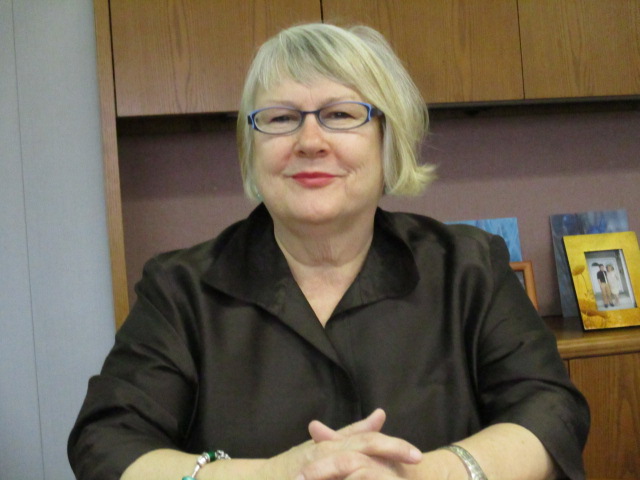
Delmarie Sadoway is the executive
director of the Public Health, Primary Care and Chronic Disease Management
Division, Edmonton Zone, Alberta Health Services.
Sikora and Sadoway’s presentation
outlined many aspects of the evacuation, including the following considerations
for those residents displaced by the disaster:
emergency response
stakeholder communication and
coordination
transportation
temporary housing
health services
financial relief
food provisions
In addition, the restoration and
public health safety efforts put into place prior to the re-entry into the
affected region were difficult, but well-executed. Many health services were
offered to residents upon their return with a strong emphasis on mental health.
The power of integration
The emergency response was
handled by Alberta Health Services which, unlike Ontario, has fully integrated
both public health and acute care. Sikora and Sadoway highlighted the benefits
to having an interconnected health system within an emergency context,
outlining the successful response to this disaster. Sikora stated, “the fact
that we [Alberta Health Services] are intertwined and interdependent creates a
strong need for good communication vertically and horizontally”.
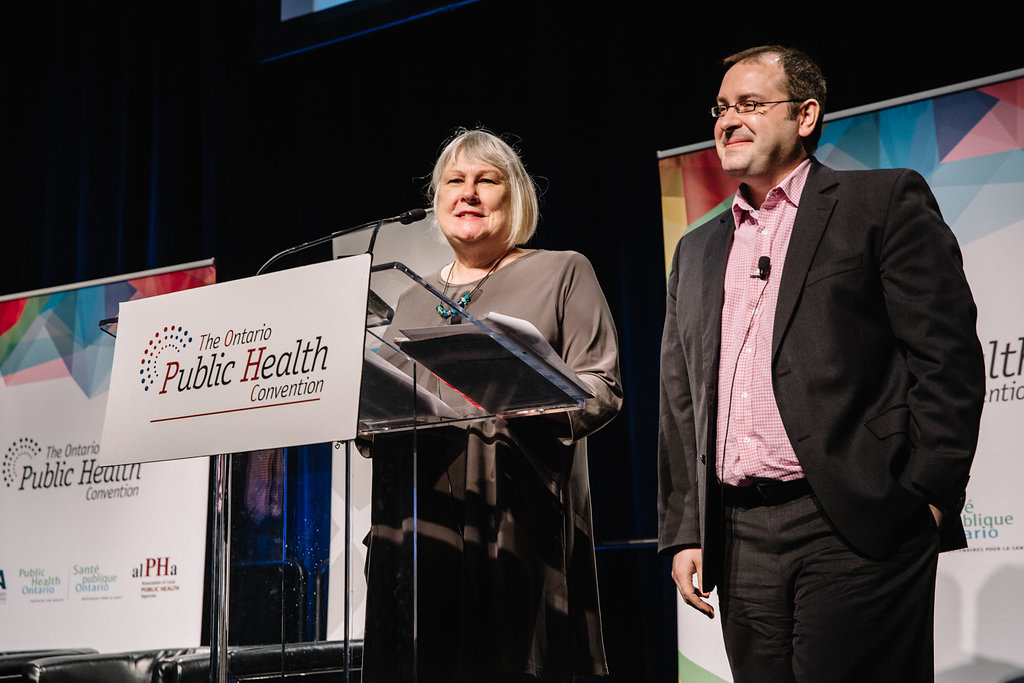 Communications and partnerships
in crises Communications and partnerships
in crises
We learned throughout the
presentation that strong stakeholder and communications coordination
contributed greatly to the success of the emergency response. This was demonstrated
in the vast numbers of private-public partnerships that were forged in order to
orchestrate the mass evacuation in Fort McMurray. These partnerships cut across
many sectors and included transportation, municipal government, emergency
responders, pharmacy services, health care, academia, insurance and
humanitarian relief. Sikora and Sadoway noted that the mobilization of
communications tools (both internal and external) improved the speed of the
emergency response, drawing our attention to the Alberta Health Services
wildfire resources webpage metrics, reaching a staggering 62,000 page views
from May – August 2016.
“Media can be your best friend in
terms of getting the messages out to the public.”
- Delmarie Sadoway
The presentation highlighted the
importance of building trust among various stakeholders during a crisis. Sikora
urges those working in public health to open up the lines of communication with
stakeholders stating, “listen to what people, communities and stakeholders are
saying…it’s vital”. The Fort McMurray wildfires disaster response could serve
as lesson for all of us, inspiring us to think beyond public health towards a
bigger goal – partners working together in dangerous and challenging conditions
to overcome a disaster and rebuild a devastated region.
The eighth annual Sheela Basrur Symposium kicked-off The Ontario Public Health Convention (TOPHC) on April 4, 2016.
Following a slightly restructured format this year, the Sheela Basrur Symposium featured a recognition ceremony, acknowledging the Centre’s award recipients, followed by the Sheela Basrur Lecture.
In keeping with the Centre’s mission, the Sheela Basrur Lecture focused on communication and leadership in public health practice, honouring the memory of Dr. Sheela Basrur, highlighting her skills in both arenas.
This year’s Sheela Basrur Lecture was delivered by physician, educator, researcher, entrepreneur and public advocate, Dr. Alejandro Jadad. Dr. Jadad is the Director of the Institute of Global Health Equity & Innovation at the University of Toronto, where he is also a professor in the Dalla Lana School of Public Health and a member of the Institute of Healthy Policy, Management and Evaluation.
Dr. Jadad’s presentation, “Bringing Back Health and Public into Public Health”, embodied the theme of TOPHC 2016 – collaborate, innovate and transform.
Watching Jadad engage and lead an audience of public health professionals is like watching a conductor at the helm of an orchestra. Generating dialogue and open discussion through live polling, Jadad created a unique and collective public health “happening”.
 His multi-platform presentation generated thought-provoking online dialogue, as
Jadad challenged people to think about public health within a broader context. Tackling issues such as social determinants of health, health and gender equity, employment and economics, Jadad confronted our perspective on how we view health. His multi-platform presentation generated thought-provoking online dialogue, as
Jadad challenged people to think about public health within a broader context. Tackling issues such as social determinants of health, health and gender equity, employment and economics, Jadad confronted our perspective on how we view health.
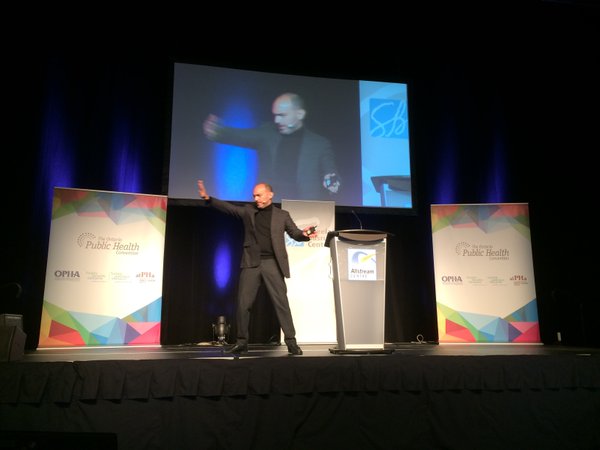
Dr. Jadad on-stage at TOPHC 2016
In breaking with a more conventional lecture style, Jadad’s presentation created a shared, experience, generating overwhelming participation and lively conversation. Jadad led the discussion, carefully interweaving all three subthemes, creating a collaborative, innovative and transformative experience within the first hour.
Traditional lectures and run-of-the-mill presentations may be on the way to becoming a thing of the past. As long as people continue to create their own content for online platforms, there will be demand for the voice of a conscious collective to be heard. The interactive experience left most feeling as though we had the opportunity to open up the dialogue by voicing our opinions on vital public health topics. Even though the discussion delved into provocative themes at times, this open forum style presentation was a starting point towards tackling significant public health issues. You’d be hard pressed to get that from a Ted talk.
What will the future look like for public health and our ability to adapt to a changing public health landscape?
On March 25, 2015, the seventh annual Sheela Basrur Symposium examined questions about how future trends will influence change in society and the impact of these changes on the public health sector in Ontario.
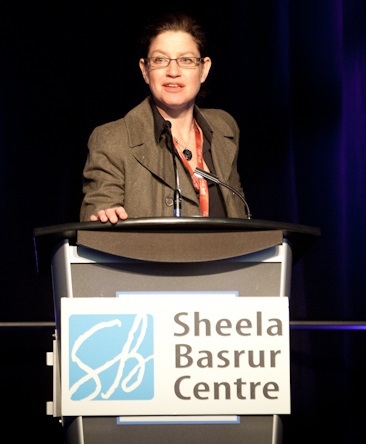 Foresight analyst and OCAD University associate professor, Suzanne Stein, began her keynote lecture speaking about some of the changes that will occur in the future, affecting individuals and shaping communities. Stein examined changes that will occur in various sectors (population demographics, security/privacy, technology, communications and health care), using an academic foresight model and strategies for creating future societies. Stein went on to further explain, “change, uncertainty, and competition are hallmarks of our time.” Foresight analyst and OCAD University associate professor, Suzanne Stein, began her keynote lecture speaking about some of the changes that will occur in the future, affecting individuals and shaping communities. Stein examined changes that will occur in various sectors (population demographics, security/privacy, technology, communications and health care), using an academic foresight model and strategies for creating future societies. Stein went on to further explain, “change, uncertainty, and competition are hallmarks of our time.”
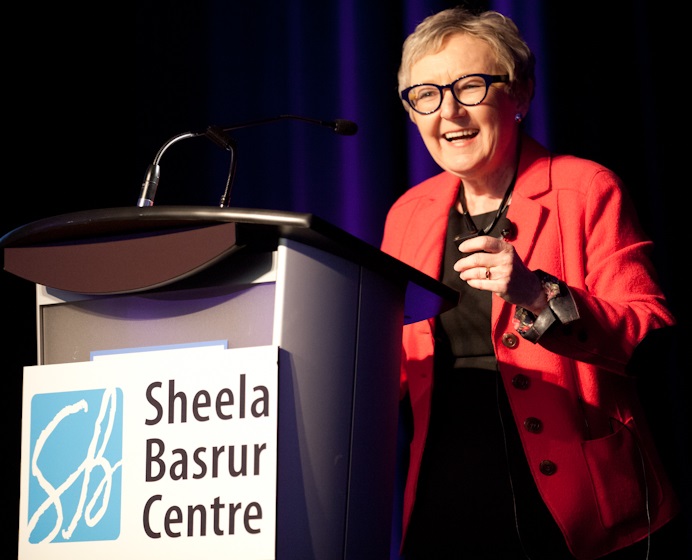
Marian Walsh, associate CEO and chief transformation officer at Sinai Health System, spoke about the future of health care and some of the changes facing that sector. Walsh touched upon various factors such as aging and demographics to demonstrate the need for newer health models, and addressed the severity and prevalence of chronic health conditions – over 70% of Canadians suffer from a chronic health condition. Using a patient complexity framework, Walsh spoke about the physical and social determinants of chronic diseases and the need for a model that addresses both clinical and social aspects of health care. Walsh also stressed the importance of communities in building this new health care model stating, “hospitals and the people in them need to see themselves as part of the community.”
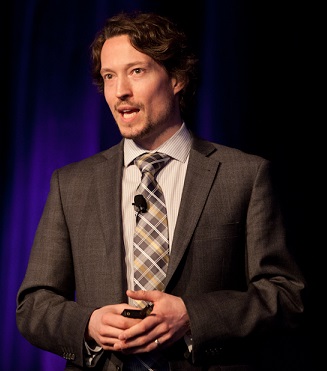 Dr. Christopher Mackie, medical officer of health in the Middlesex-London Health Unit, reflected on the changes ahead in the public health sector. Building upon the Centre for Disease Control’s 10 Greatest Public Health Achievements of the 20th Century, Dr. Mackie identified public health achievements for this century and the changes in public health practice. While Dr. Mackie touched on several public health issues that we are currently facing, he also offered a path forward in addressing these issues. One approach he discussed was that of “enoughness” in relation to resource consumption for the individual and the community. Dr. Mackie suggested that Canada needs to adopt this notion of "enoughness" stressing, “the individual succeeds if the community succeeds.” Dr. Christopher Mackie, medical officer of health in the Middlesex-London Health Unit, reflected on the changes ahead in the public health sector. Building upon the Centre for Disease Control’s 10 Greatest Public Health Achievements of the 20th Century, Dr. Mackie identified public health achievements for this century and the changes in public health practice. While Dr. Mackie touched on several public health issues that we are currently facing, he also offered a path forward in addressing these issues. One approach he discussed was that of “enoughness” in relation to resource consumption for the individual and the community. Dr. Mackie suggested that Canada needs to adopt this notion of "enoughness" stressing, “the individual succeeds if the community succeeds.”
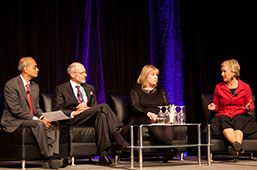
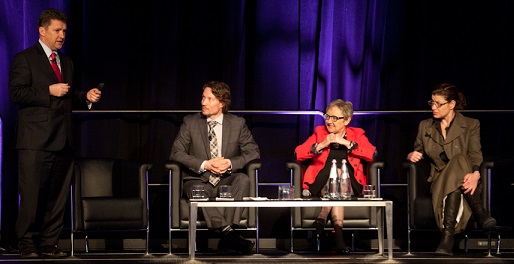 From left to right: Peter Donnelly, Dr.Christopher Mackie, Marian Walsh and Suzanne Stein. From left to right: Peter Donnelly, Dr.Christopher Mackie, Marian Walsh and Suzanne Stein.
After sharing their unique insights, each panelist contributed to a lively Q&A discussion, moderated by PHO’s president & CEO Peter Donnelly.
The Sixth Annual Sheela Basrur Symposium
On March 31, 2014, the sixth annual Sheela Basrur Symposium explored the relationship between public opinion, science and the media in influencing health policy. The panel, consisting of a renowned journalist, a political communications expert and a medical officer of health, each provided their own unique insight on this critical interplay.
Throughout the Symposium, our expert panelists described how media and science work together to influence public views and how government health policy is shaped by media and communications. Each panelist stressed the importance of messaging out through the media to ensure that vital public health information is received by the masses. Given the rapidly changing media landscape, public health professionals must capitalize on traditional and new media to sustain and influence public opinion within a health policy context.
Award-winning journalist and keynote speaker, Trudy Lieberman, examined how media and science come together to shape public attitudes, drawing on recent U.S. examples with Obama Care. Lieberman discussed three key ways public health professionals can communicate effectively with the public through the media: using facts, fiction and framing. Lieberman urges public health professionals to be persuasive with the public, arguing that messaging should be less about facts and emphasize how messages are crafted by public health professionals. Lieberman stated, "The best facts are not always the most persuasive. Facts are often not enough to overcome powerful fiction. Framing your messages is key."
Lieberman has observed timidity within public health communication, arguing that this is likely rooted in a fear of controversy and, in turn, losing support from funders. She urged public health professionals to be more bold in their communication with the public.
Jim Maclean, political communications expert, provided an Ontario perspective, identifying communications strategies that have successfully shaped public opinion and policy on key health issues. He presented six effective television advertisements produced in 1988 by the Ministry of Health aimed at educating the public about AIDS. Each video debunked myths about how the disease is contracted and closed with a powerful message, "Not knowing creates fear. Knowing the facts is the first step in protecting yourself. Let’s talk."
Maclean maintained that although these ads were created over 25 years ago, governments today can still apply the same principles in messaging out to the public with defined and consistent communication. "We need clear communications like what was used for AIDS in the 80s," quipped Maclean.
Maclean also addressed the challenges around vaccination campaigns, insisting that we tend to spend more money on devising campaigns for motor vehicle education and second-hand smoke than on influenza. He also echoed Lieberman’s call for bolder public health communications.
Dr. Ian Gemmill, medical officer of health in KFL&A Public Health, outlined how he uses social media as a key strategy within a local context, shaping opinion and policy in a digital medium. Although the uptake in social media usage has slowly started gaining momentum in public health, local health units in Ontario still have a long way to go in the adoption of digital platforms like Facebook and Twitter. Gemmill believes that less public health presence online increases missed opportunities for public health professionals to convey timely health-related news and information to the masses. He insisted that, "public health cannot afford to not use social media as a tool for health protection and promotion."
Gemmill also spoke about the merits of social media in terms of using the platform to open up the public health dialogue with key stakeholders and politicians within communities. "Twitter is a new way to subtly be in the face of politicians," explained Gemmill. He also emphasized using new media as a way to both engage with journalists and challenge his opponents within the public forum provided by these social networks. After each panelist had an opportunity to speak, TOPHC delegates engaged in a lively Q&A discussion with the panel, moderated by Public Health Ontario president and chief executive officer, Vivek Goel.
Thank you to all of our panelists for making the sixth annual Sheela Basrur Symposium a huge success. |
"Public health is not a beat that reporters want to cover unless there’s an epidemic."
– Trudy Lieberman, journalist
"Why don’t we care as much about exposing patients to the flu as we do about exposing them to second-hand smoke?"
– Jim Maclean, communications expert
"If we don’t embrace social media we may miss the chance to make a change."
– Dr. Ian Gemmill, medical officer of health,Kingston,Frontenac, Lennox & Addington (KFL&A) Public Health
Vivek Goel (left), former president and CEO, Public Health Ontario, with Trudy Lieberman, Jim Maclean and Dr. Ian Gemmill.
|
The Fifth Annual Sheela Basrur Symposium
On Wednesday, April 3, 2013 over 700 public health professionals gathered to attend the fifth annual Sheela Basrur Symposium. The symposium marked the 10th anniversary of SARS, reflecting on how the media and communications landscape has changed over the last 10 years and how this could potentially impact the next public health crisis.
Public health communication during an infectious disease outbreak presents a unique set of challenges. Rapidly evolving events require timely communication between multiple parties and the public. Policy decisions are made and health messages communicated usually under uncertainty about the magnitude and exact nature of the risks. The risks involved are not only those directly related to illness and mortality, as poorly handled communications can create or exacerbate perception or understanding of risks, leading to the inappropriate use of healthcare, panic purchasing of stockpiled food/medicines and the stigmatization of people and places.
“Infectious diseases threaten our sense of control,” said Julie Leask, associate professor at the School of Public Health, University of Sydney and the Australian National Centre for Immunisation Research & Surveillance. “Health reporting is about balancing detail, integrity, research and depth of storytelling with time.”
Leask’s keynote lecture highlighted effective communication strategies during emerging public health issues.
Panelists also reflected on how new technology offers exciting opportunities to convey timely messages to the public, while also increasing the potential for communications crises. Both the value and effectiveness of utilizing social media in health reporting and outbreak communications were explored by the panelists, urging public health professionals to get more engaged in social media.
“Twitter has become the new broadsheet,” said Wayne MacPhail, social media expert and journalist.
MacPhail emphasized how social media is about conversation and can be used as an effective public health communications tool. He called on public health professionals to “be in the moment, be part of the conversation, be proactive.”
Digital technology offers a surplus of platforms to access timely news items. With this change in technology and accessibility, the way news content is created, captured and consumed has transformed considerably. Long gone are the days of relying exclusively on media organizations to inform the public of current and newsworthy events.
Most people can now generate and consume news content instantly via the internet and social media platforms like Twitter. The fragmented news landscape requires credible and trustworthy public health spokespeople working with the media to craft and communicate clear, accurate and detailed messages.
Helen Branswell, Canadian Press medical reporter, shared insight into the current state of her profession. Branswell maintained that traditional print media provided greater detail in news stories, and that media outlets repackage this content for different platforms. Her stories may appear online, in print or as video content. Branswell also tweets. Regardless of format, Branswell stressed that trust is critical for spokespeople in outbreak communications.
|
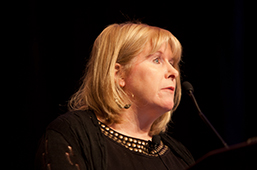
 Dr. Julie Leask
Photo credit: Michelle Yee
Photo credit: Michelle Yee
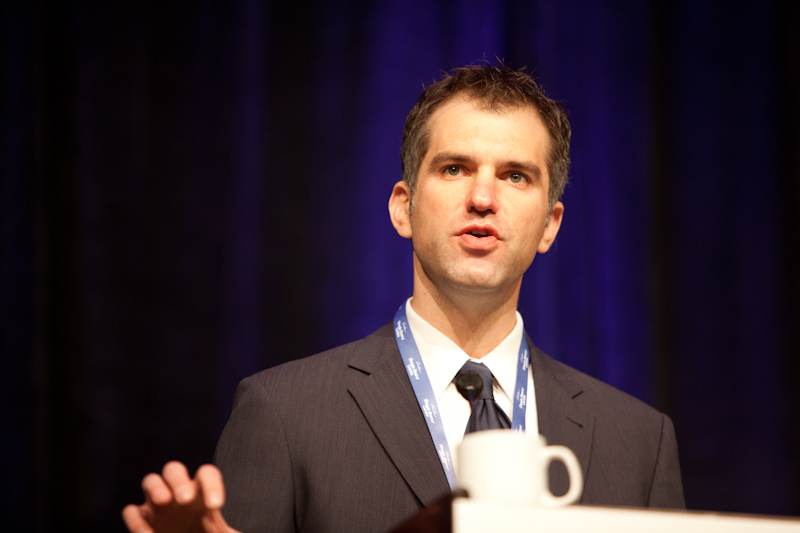
 Helen Branswell
Photo credit: Michelle Yee
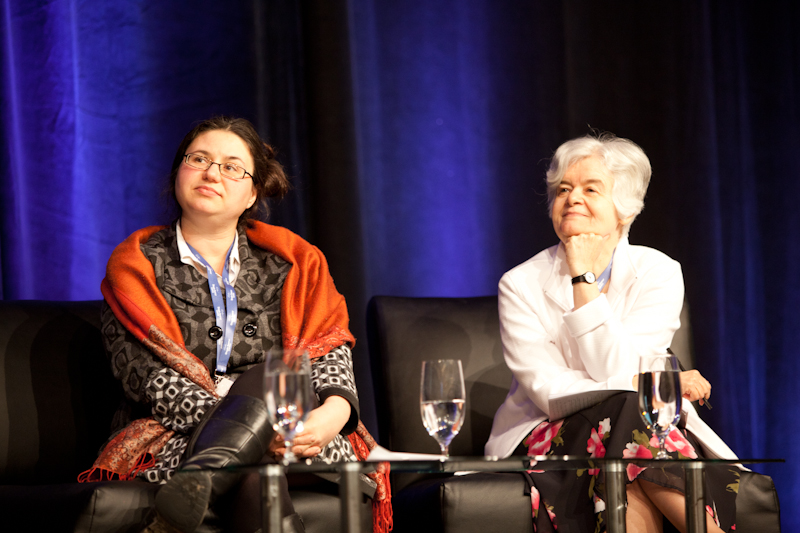
 Vivek Goel, former President and Chief Executive Officer of Public Health Ontario, with panelists Wayne MacPhail, Helen Branswell and Julie Leask
Photo credit: Michelle Yee |
The Fourth Annual Sheela Basrur Symposium
 On Monday, April 2, 2012, three dynamic and engaging speakers addressed the controversy surrounding vaccinations at the fourth annual Sheela Basrur Public Health Symposium, “Changing practice in a changing landscape: vaccine wars, science and new media.” The speakers tackled critical, challenging questions about communicating to the public including: On Monday, April 2, 2012, three dynamic and engaging speakers addressed the controversy surrounding vaccinations at the fourth annual Sheela Basrur Public Health Symposium, “Changing practice in a changing landscape: vaccine wars, science and new media.” The speakers tackled critical, challenging questions about communicating to the public including:
- counteracting misinformation building
- trust and improving access
- being open and transparent about risks and the unknown in public health
- developing new social media strategies and platforms to better engagement
 Seth Mnookin, an award-winning journalist and author of The Panic Virus: A True Story of Medicine, Science, and Fear, Dr. Noni MacDonald, a leader in paediatric infectious disease, and Dr. Jennifer Keelan, an expert in the use of social media for knowledge exchange and behavioural change, applied their collective knowledge and expertise in a thought-provoking panel discussion led by Dr. Vivek Goel, President and CEO of Public Health Ontario.
With a particular focus on immunization, each speaker offered unique insights into how to convey important public health messages to the public and develop effective means to influence behaviour and bring about positive health outcomes.
The symposium would not have been possible without the generous contributions of Pfizer, which sponsored the event in large part through a generous unrestricted educational grant.
The Third Annual Sheela Basrur Symposium
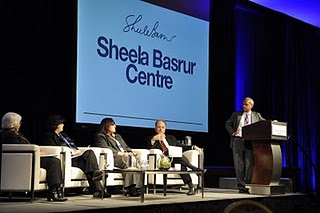 The third annual Sheela Basrur Symposium served as the lead-off event for the inaugural The Ontario Public Health Convention (TOPHC), on Wednesday, April 6, 2011, at Toronto’s Harbour Castle Hilton convention centre.
To mark the 25th anniversary of the Ottawa Charter for Health Promotion, the symposium explored “Health Promotion in Ontario 25 Years after the Ottawa Charter,” and sought to answer the questions: “What have we achieved?” and “What still needs to be done?”
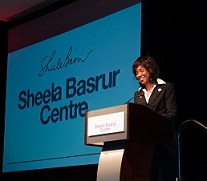 |
| Hon. Margarett Best, Minister of Health Promotion and Sport |
In his keynote address, Irving Rootman, visiting professor in the department of gerontology at Simon Fraser University, provided an overview of the Charter. John Garcia, program leader for the master of public health program at the University of Waterloo, followed with a keynote address examining the Charter and health promotion in Ontario. Vivek Goel, President and CEO of Public Health Ontario provided introductory remarks and moderated a panel discussion which followed the presentations. Panellists included Sandra Laclé, Angela Mashford-Pringle, Ruth Grier and John Garcia. Dorothy Pringle, chair of the Sheela Basrur Centre Advisory Council, offered closing remarks.
The Second Annual Sheela Basrur Symposium
Current debates around eating locally, the benefits of eating organic foods, individual rights to sell unpasteurized milk and the recent outbreaks of foodborne illness are issues that have garnered the attention of media, politicians and public health professionals. Amidst all of the debates, what are the latest research findings and scientific knowledge in this area?
The Second Annual Sheela Basrur Symposium entitled, “Food, Fads, Facts and Fiction...How Safe Is Our Food?”, stimulated discussion and debate on the topic of food safety by exploring the current state of our food system from a variety of perspectives, including public health, political, environmental, economic and social. Food experts from a range of disciplines discussed the topics of food safety, the benefits and risks of eating organic versus conventional foods and the arguments behind the growing local food movement.
Session 1: Food Safety
- Food Fads, Facts, and Fiction: How Safe is our Food?, Tim Sly
- Health Benefits & Potential Contaminant Risks of Eating Fish, Judy Sheeshka
- Food Safety Starts on the Farm, David Kelton
- Session 2: Systems Thinking
- Canadian Food Safety: Impediments to Improvement, Rick Holley
- Food Production and the Determinants of Health, Craig Stephen
- The Enjoyment of Eating: What is the Role for Public Health?, Catherine Mah
- Session 3: The Local Food Debate
- Panelists engage in the local food debate.
Inaugural Sheela Basrur Centre Symposium
The H1N1 Flu Outbreak presented a number of challenges and opportunities for public health officials, including coordination and communications within public health and with the public. The symposium provided an opportunity for dialogue and discussion with Public Health Ontario scientific and medical experts, journalists and health educators.
- Session 1: Managing and Monitoring the Pandemic Threat
- Session 2: Pandemic Information – Hyping or Helping
|